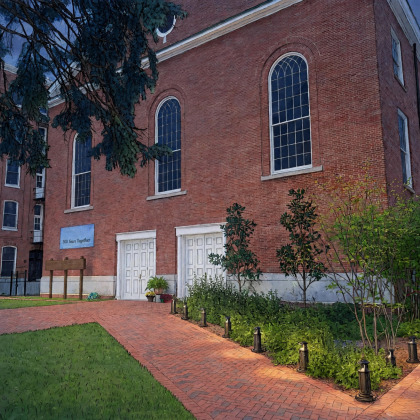
Good Friday Reflections 2024
For the next several weeks we will be sharing Good Friday reflections from our congregation.
From Clare M:
Matthew 27.24-34
I did a bit of reading this week, thinking about this reflection — going back to old books from a college class on liberation theology, along with some “Bible made simple” explanations of these verses from Matthew. One phrase in the commentaries I read stood out to me: “it can be hard to imagine Jesus being mistreated with such profound cruelty.” I know the writer likely meant that it’s painful to imagine this scene, but there also seemed to be a suggestion of the unimaginable: can you believe it? Can you believe people would treat Jesus like this?
I couldn’t help thinking, have you met us?
For me, this story is all too easy to imagine. Not just the large scale cruelty that history, and the world around us, give plenty of evidence for. On a much smaller scale in my own life, I can recognize it all. Being in a position of authority, giving a self-righteous sniff and thinking, “well, I gave them the option to make a different choice.” Being part of a mob who sees a public figure as entertainment rather than a real person — I can recognize that. And I can imagine how these small moments can tip over into their most profoundly cruel versions.
We have all kinds of evidence for the cruelty in this story; it’s painfully easy to imagine. I know, though, that there’s another part of the story, which is very nearly impossible to imagine (especially for someone who wasn’t raised in a strictly Christian tradition). Tonight I’m asking myself to be open to a version of the world that we don’t seem to have much evidence for. I’m trying to open my heart to what is very nearly impossible to imagine.
From Renee C:
Luke 23.44-49
I find this passage to be truly the darkest and most difficult one to read in the Bible. Reading about Jesus being tortured as his loved ones stand by helplessly and others gather around to cheer is terrifying and heart-wrenching. Hearing about the moment of his death is so incredibly sad it leaves one feeling hopeless.
Yet there is also some hope that we can take away from this story. When the Roman soldier witnesses the death and the aftermath of the sky becoming dark and “the curtain of temple being torn” he is convinced of Jesus’s true godliness. Others upon seeing what happened go away “beating their breasts” in mourning and regret for what they have done. Seeing the impact of watching the event on complete nonbelievers as they realize they have killed the Son of God does bring back some light as a glimmer of hope burns through.
As a child of the 60’s and 70’s I was strongly influenced by the Hollywood movies of Bible stories. They brought them to life in very impactful ways. Whether their interpretations were accurate or not was irrelevant to me as a child. We could only imagine what the people there in that moment felt. Because they managed to embody the feelings, we too could feel what they may have been experiencing.
Despite its darkness, I can take away hope after reading this. Hope that in our divided world we can be peacemakers and try to heal some of those divisions.
From Anna S:
Matthew 27; 45-49
Hello everyone. Please join me in reflecting upon the passage from Matthew 27; 45-49.
After reading through this excerpt multiple times, the part that stood out most to me was how misunderstood Jesus was by the bystanders. These people misunderstand his cries for help when they believed he was crying out for Elijah when in reality he was weeping for answers from God. They misunderstand his wants and needs by offering sour wine vinegar when in reality nothing at all would mitigate his pain and agony. These seemingly futile misunderstandings during Jesus Christ’s last moments on the cross actually highlight the more significant misjudgments made against him during his first journey on Earth. The misjudgments of disbelieving that he was the son of God, which ultimately led to his abysmal demise.
As I was trying to connect these themes to my own life, I was reminded of my experience in babysitting. When interacting with and caring for young children, it is often hard to understand them, but with enough patience and effort, an effective system of communication and understanding can be created. Many people are too fast to just reject any attempts that require patience and effort.
One lesson that people can take away from this passage is that we need to approach life with enough patience, mercy, and openness to effort. I believe that attaining these qualities leads to a life full of love and peace. And that is what we truly strive for.
From Jane H:
John 19: 31-42
In the spaces that we have shared during Lent there is a certain search going on, for meaning, for perspective, for connection to each other. This search is important because it is not just about finding answers but discerning the significance of these moments, the baptisms, the Palm branches, the repair to the ceiling and the light that shines through, the small girl running on the balcony, stunned by the freedom she has, her mother close behind and community food and meals. The music in the beautiful song we heard tonight, prompted by the question, “Were you there?” Each one of these moments, in its retelling, accumulates meaning and grows in our memory.
The process we go through of discerning meaning, not determining it, is important when we stand in front of texts like the one we hear from the gospel writer John. John can be thorny, but the story it tells is a perspective that has been put in front of us, and I think its challenge makes clear that the work of theological understanding can never be static, finished, complete. Because if it is, I no longer stand in front of the mystery that is God and challenges the limits of what I think I know. In this regard John’s story is deeply liturgical, because it bears repetition. That is, it supports a rehearing in search of meaning. It already remembers the events of Maundy Thursday, of the command to break bread together in commemoration. So when we hear Jesus’ words we hear them in the full knowledge of what will come and what has come before.
The writer of John records Jesus’ words, “I am the bread of life.” Not the Lord, not the Savior, but the bread. Imagine. Bread. But bread is the thing that changes everything if you don’t have it – and those who didn’t have it were the ones Jesus stood before. They came to hear him empty handed and went away miraculously full. It is hard to receive this image in all its complexity because perhaps we are not in that place at this moment. But that place is where this text takes us.
Tonight we are caught in a crisis of learning how to make sure each of us is cared for. This does not reflect the complexity and diversity of each of our thoughts and each of our capacity for care. We understand what was happening to the people who saw Jesus. They saw someone who stood before them, addressed their profound need, was full of compassion, and who met them in the places of their deepest suffering and isolation. Being present to this exchange we know that no one should ever be without care.
The miracle of the gospel is not the saving promise still to come but the compassion exchanged in the moment, of the darkness in anticipation of the light. It is easy to get stuck understanding the metaphor or the allusion, it is difficult to remain in the place of compassion, feeling and healing. To be present to it, to share it. To talk about what it really means to be a people in the presence of inequality, recognizable by our compassion, not our creed. The gospel reminds us that what changes everything is care, not power. Our challenge is to understand how to begin from this place of darkness to talk about what will help all of us alike. We move closer to understanding the struggle when we have a conversation in which compassion is our teacher. Knowing that compassion does not give us any answers, but places us, again and again in the presence of one another, fully aware of the mystery and the deep places we carry. When we recognize each other in those places, we are present to each other in the spirit of God’s love and anticipate the light of resurrection.
From, Holy Week
Good Friday
The thought is to walk away.
To watch the rush of water, to not fear drowning.
To hear the continuous movement of the stream
The blue of the Broad Brook
The tumult
The gentleness
To see the stones beneath the moving surface made vivid by the fragile air.
The goal is to stop asking questions, to be silent.
To think, to be in a clearing before a wall of woods.
To walk, to study the weather
To not be concerned about sleep.
There is a bicycle leaning against the wall of a weathered white house.
There are cattle looking up from their hay.
In less than an hour
The sun will rise
Snow
Will cover the fields of brown grass and brilliant green fern
with a thin,
white scrim.
Then the seven last words will live in the valley
And the darkness will remain filled with stars
Who also wait in anticipation of the light.
Blessing
In the darkness, and in the stillness, May the love of God go with you tonight and may you know the
healing grace of God’s promised peace.
From Nancy D:
Mark 15:25-32
Mark’s writing almost sounds like an article from a newspaper…possibly a continuation of an earlier story with which the readers are already familiar. He gives us minimal scene-setting: He reports the time of day…..He reports the criminal charges against Jesus…..He reports how the crosses are arranged with Jesus in the middle–between the two thieves.
Then Mark switches his perspective. Now he shows the smug superiority of the passers-by. (Perhaps an echo of the story of the man beset by robbers?) The passers-by, once part of the crowds who heard Jesus teach, deride Jesus as fake. The religious leaders mock Jesus and, after throwing Jesus’ own words back at him, gloat that Jesus cannot save himself. The lack of feeling on the part of the onlookers regarding what is actually taking place is clear. And the stark reporting with real-time quotes makes this long, awful event all the more terrifying. Hopeless. Jesus is dying. Profound love–lived love–is dying.
From Shelley L:
John 19, 17-24, 28
Good evening.
I am Shelley L. and I have been attending Old First the past few months. I have felt welcomed since my first visit in November. This evening, I will be reflecting on the crucifixion and John, chapter 19, verses 17-24, 28. I have attended numerous Good Friday services, but this is my first time reflecting on a topic related to the passion of Christ. As a kid, I struggled with understanding why we call it Good Friday, when it was the day that Jesus was crucified and died. After I picked the topic and read the scriptures, I questioned my decision. Why would I want to talk about a topic that evokes violence, brutality and sad images of Jesus on the cross? Then, I thought, there is a message in the verses and I needed to take time to reflect on them. I think of the ways Pilate and his soldiers tried to humiliate Jesus and break his Spirit.
First, Jesus had to carry his own cross to a place called Skull, which in Hebrew meant Golgotha. I imagined a tired, exhausted and weary Jesus carrying a heavy wooden cross knowing he was walking to his death. Then, Jesus was placed in the middle of two other men, who were allegedly convicted criminals. How could our Lord and Savior, someone who changed people’s lives and perfected miracles be in such an awful situation.
Meaning of writing on the cross
Pilate wrote on the cross or in another translation, had a note nailed to the cross which stated Jesus of Nazareth King of the Jews. It was written in Hebrew, Greek and Latin. The chief of priests told Pilate to rewrite it to state that Jesus said he is the King of the Jews.
Pilate responded “what I have written, I have written”. Or, translated in today’s language, as NeNe Leakes from the Real Housewives of Atlanta stated, “I said what I said.” I thought about the word choice. I’m an attorney and words have meaning. So, I reflected on Pilate’s version versus the chief priest’s wording. Pilate’s statement seems to state a fact, while the priest’s version states Jesus’s words. I wonder why Pilate chose to keep his wording? I wonder if Pilate was trying to mock Jesus or did he deep down have a feeling that his words accurately reflected the truth of what Jesus had been saying all along.
Clothing
The soldiers took his clothes and left him in his undergarments. That action was another way to humiliate Jesus. They divided his clothes among 4 soldiers. The soldiers decided not to tear the robe they took off of him. Instead, they cast “lots” for it. For someone who was being crucified and treated as a criminal, it seems odd that the soldiers wanted to keep his clothes. And, they decided not to ruin the garment and literally drew straws or “raffled” it off to determine who would keep it. Even the soldiers saw something in Jesus that they wanted a part of him during this moment.
Final words
Jesus knew his death was approaching and he had fulfilled his destiny. He said, “I am thirsty.” When we are in our darkest hours, what do we “thirst”? Do we thirst for vices that make us feel better, self-help books or do we thirst for God and God’s love? Do we have the faith to hold on to God’s love when the darkest storms impact our lives? The crucifixion reminds us that Jesus paid the highest price for our sins, but God was with him through it all. God is with us through all of our trials and tribulations and will not let us down. Through Jesus’s sacrifice on the cross, he paid the ultimate price for our sins and we are reminded of his love for us so we can have eternal life.