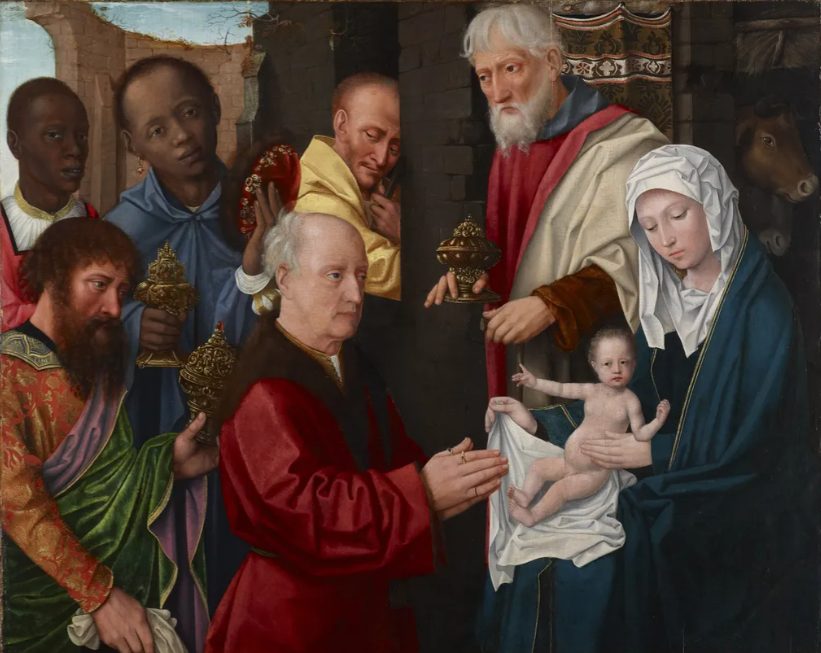
The Magi, in Mathew’s Gospel, are Wise Ones, esoteric astrologer clerics. Most importantly, they are Gentiles — non-Jews — who travel great distances to kneel before the child born King of the Jews. Matthew is indicating symbolically that this Jesus and his Kingdom will have significance for the whole world.
But the story doesn‘t stop when / where the canon of Scripture closes. More details ’keep coming to light“ (a nice metaphor for Epiphany). We learn there were three Magi (unless you‘re in the eastern church where the story says there were 12). We recognize them as Kings, but only because in the Psalms and Isaiah Scriptures says ‘Kings shall bow do before the King of the Jews.’ The Magi, over time we come to know, came from the different continents known in the ancient world: they are African, Asian and European. As the centuries go by, we can even see their diifferent ages – a youth, an adult and an elder. They have names too: Balthazar, Gaspar, Melchior.
None of these details were known or communicated by Matthew in his Gospel. Neither apparently were they part of the oral traditions that the Gospel writers mined. We are unable to trace the sources of these characteristics fleshing out the story of the Magi. And yet we know exactly where these attributes come from. They sprang from the living and witnessing of the Christian faith.
Jesus started his ministry understanding his call as ‘a reforming rabbi working to make the Judaism of his day more spiritual, heartfelt and personal.’ But Jesus’s sense of call grows as he lives out implications of his own preaching and teaching. His vision, attention, care, healing get wider. His experience of ministering in God’s love pushed him beyond the particularity and bounds of his Jewishness.
A similar movement happened over and over again in the church. In the ministries of Peter and Paul. and the early church. Even in the creation of the Christian writings. And on down through the centuries. Over and over again this complicating and reinforcing push from particular to universal. The church driven to take the love of God out and to bring the insider in to an increasingly diverse Christian community.
The love of God is expansive; it keeps breaking down the barriers. God’s love, by definition, is not discriminating. Through the centuries, we see the church re-casting its nets ever wider. We see the Holy Spirit driving the church to take God’s love further and further astream. In the Magi, Matthew showed from the beginning that Jesus’ reach was beyond his own people. And the tradition goes much farther. The faith in his name burst beyond its Jewishness and the Law. And all the rules of separation. Out into the classical world, Into Greece and Rome. And eventually around the globe.
But the inclusivity of the church Isn’t just a repudiation of our modern Herod, his anti-DEI crusades and racism. The diversity of the church is a measure of faithfulness. And instrumental for God. The church creates a new unity out of diverse peoples to show – in microcosm – a better way for humans to live.
Christianity looks out at the rulers of this world – Alexander the Great, the Syrian monarchs, to Egyptian Pharoahs, and Ceasar on the throne. And then visions God’s government in Jesus in unthinkably different ways. No longer about dominination. Because Jesus does not think that equality of God is something to be exploited. Instead, he’s born into human life, poor, vulnerable, dispossesed, as a slave if you will.
Alongside of Jesus, God gathers a new community. A community of people radically diverse in ways the world doesn’t abide. A great multitude of every nation, kindred. tribe and tongue. They all belong as equal citizens in the small model of a new creation which we call church. Little cells of unlike people, Judean, Gentile, female, male, slave, free, Barbarian, Scythian. Anyone from anywhere; indeed everywhere – with no other precondition or qualification except their (our) loyalty to King Jesus. And our wanting to show / share a better way in a world still dominated by Ceasar and Empire.
In the Judasim of Jesus’ days, the Law forbade Jews from sitting at table or sharing a meal with Gentiles. Consider then how radical Christianity’s communion table was / is… with room enough for ALL, with no exceptions. It’s nothing less than a sign and forestaste of a more abundant way of living… the Kingdom of God.