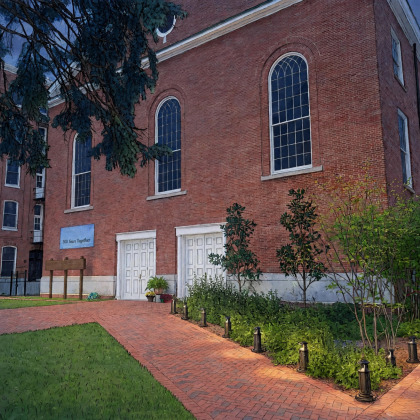
Michael was invited to come and speak to Society Hill Synagogue’s “adult forum” last Saturday, April 25. He was supposed to introduce POWER Interfaith as an option for faithful involvement of people from Jewish, Muslim, Christian, Quaker, Ethical Culture… beliefs. He thought sharing it might help some Old Firsters get to know POWER Interfaith better…
______________________________________________________________________________________________________
I’m Michael Caine, Pastor at Old First Reformed UCC @ 4th / Race, one of the founding congregations of POWER Interfaith, now 15 years old.
I am also one of the POWER’s Board Co-chairs.
POWER Interfaith’s biggest political successes have been winning the $15 minimum wage for workers, first at the airport and then for any business with a contractual tie to City government.
We also won the Full Fair Funding fight involving the state supreme court’s decision and the Gov.’s multiyear plan to properly fund public schools across the Commonwealth.
Currently, we are organizing in Philly, Montgomery County, Lancaster and the Lehigh Valley.
* * * * * * *
I need to begin with a question –
I know Christian theology has an ambiguous, uncomfortable, sometimes dishonest relationship with power (small p).
Of course it’s ironic (or entirely about this fact): since the Emperor Constantine, the church in the west has almost always been aligned with the ruler.
Perhaps, apologetically, the church’s confusion – or is it play acting??? – is not being able to square worldly power and privilege vis a vis a spiritual tradition that invites us to humility, service, even vulnerability (like Jesus).
It feels almost an impolitic question for a Christian minister to pose to a Jewish community, since your history has been plagued by the Christian society’s mistreatment of its Jewish neighbors.
BUT
“how in Jewish practical theology…” – or what I really want to hear is – how in the real life of this congregation… How do you all feel about power (small p)?
(One more comment, before I make room for your answers, it’s a confession really: I googled the question, about a Jewish understanding of power, and I got an answer that could essentially work for the church too):
“Jewish practical theology views strength not as self-sufficiency, but as utilizing personal capacities for divine purpose, while weakness is seen as a conduit for humility, divine dependence, and ultimate strength.”
Ultimately, this practical approach teaches that when a person recognizes their weakness and humbles themselves, that process allows God’s strength to be channeled through them, effectively making “weak things become strong”.
AI used Moses as just such an example.
OK, then,
What do you say,
how do folks at Society Hill Synagogue
feel about power (small p)?
(People had a lot to talk about, particularly about how different they felt after Oct. 7 in justice organizations that had previously been comfortable homes for their activism.)
Ok, you know why I ask? …because if I’m supposed to talk to you about the organization POWER, we need to focus on power – real, concrete political power.
POWER at 15 is in the middle of a cultural shift as we recommit to base-building, raising up everyday citizens who have a hunger for public life. Regular folks who can identify their self-interest in public engagement and becoming leaders.
To explain this, I’m going to start with the Save Chinatown fight.
At POWER we always believed 76Dev Corp’s play for a Center City arena was really a developer’s long term game. A land grab ultimately to undermine Chinatown in order to free up prime Center City real estate, redeveloping, gentrifying the last working class neighborhood in Center City.
And as the battle ended, what did we see happening? Does someone want to characterize the ending of the Center City arena fight?
(The developers decided what they wanted in a backroom totally independent of the working of city government or the self-interest of our city’s people.)
…When the Developers are talking to each other, even the Mayor and City Council, it turns out, don’t have a say.
We don’t believe that’s how our city should work. We believe that our elected officials should be leaders in the fight to make sure this city finds a way that serves everyone. And in order to counterbalance the monied power of developers and corporations, we believe in organized citizens working according to their own self-identified, self-interests to wield political power strategically and effectively.
Essentially, this organized citizen power rights the power imbalance when monied interests are calling all the shots. Organized citizens’ power calls our electeds to accountability for their elections.
We’ve seen in just the last few months, how a show of real political power can make a difference. As we wanted to begin speaking with our city counselors about our questions and concerns which are becoming our Affordability Campaign, POWER leaders couldn’t even get meetings a year ago with them. City Council offices didn’t even bother to call us back.
But now, having pulled off our Feb. 1 Assembly at Mother Bethel (how many of you were there?) …On one of the coldest days of the year, gathering over 500 citizens concerned about our city and this housing unaffordability crisis, powerfully engaging 2 City council leaders…
And out of it having published a report on the Affordability Crisis… that’s been delivered to all 17 council members – now we find the Councilpersons have a newfound interest speaking and working with POWER! But we aren’t looking for (small p) power for its own sake.
In the last few years, in our organizing across the city, we began to see that almost every neighborhood – and particularly certain Black and brown neighborhoods – neighborhoods and their residents are being adversely affected by increasing unaffordability. Housing costs have been rising dramatically. Taxes. Utilities. It’s all rising and converging on the limited resources of regular Philadelphians.
In a housing meeting research campaign two summers ago, where we spoke with over 800 Philadelphians, we learned that 30% of “our people” – the folks we gathered from neighborhoods we’re organizing in – 30% of households regularly cannot pay their monthly housing expenses.
In the midst of our housing prices skyrocketing, we’ve recognized another ominous trend as well: the city’s future revenue is tightening dramatically. It’s clear that Washington is withdrawing dollars. We also saw last June, city council voted to eliminate the BIRT (Business Income / Revenue Tax) – which over 12 next years, will eliminate $2.8B from the city’s coffers (that’s ultimately a 14% cut in the city’s revenue).
It’s almost as if City Council is unaware of, or hiding its head in the sand, about looming, growing budget shortfalls. We need our mayor and our City Council to make a serious commitment to making this (POWER’s old mantra), a city that works for all, a city that works for everyone, all the way to those who feel the pain of our economy’s shortcomings the most.
But we’re worried if city officials don’t get serious about identifying alternative revenue sources (that are not just more property taxes for people who have already seen a huge increase)… if our electeds cannot find more $, we worry, there will not be the resources to tackle some of the biggest issues facing us. (I mean, look at how our schools languish?)
If City Council and the Mayor don’t get proactive, they’ll end up passing on the need for more revenue to more property taxes that will raise costs for homeowners and renters alike. …Like they are already doing with the new taxes on rideshares and deliveries.
And if our leaders don’t get serious about developing policies and programs to address the growing unaffordability crisis, our city government will become a victim of high prices like the rest of us.
We want to help our elected officials get serious about these issues.
Serious about finding revenue. Serious about where new taxes need to land. Serious about taking action to make housing costs, living in Philly, less problematic for Philadelphians.
We want to help our electeds move on what this city needs.
To change the playing field so it’s not just the Developers calling the shots. To change the playing field so City Council and the Mayor become proactive agents for improvement. The developers have their role to play. But it’s not orchestrating everything their way.
So does city government have a crucial role it could rise to. And most deeply, we believe in average citizens engaged in public life – we should have an equally important and powerful role to play.
So what’s POWER Interfaith up to? We’re launching our first city-wide campaign in 10 years. Our “We Make Philly” campaign. With an agenda to make sure our city is fully funded and fully affordable.
We have yet to decide –
Our campaign demands,
Our targets,
Our plans for continuing to build power / POWER.
I began with a question for you,
I think I want to end with one too:
Do you want to join us, building the power to force change. Rewriting power relations and material conditions rather than just advocating for justice, or trying to keep the worst possible from happening?
And what would it take for Society Hill Synagogue to step up and take responsibility for organizing its people to build real power?
(ANSWERS from Society Hill leaders.)
In organizing, at the end of a meeting, there’s almost always a formal ask, to gauge the relationship that’s been built, to test your power…
I have an ask for you all today –
On Friday May 1st, a week from yesterday, from 4 to 6 in the afternoon,
POWER will be marching with others, mostly the Unions – it’s May Day! – as a visible sign of our demands, taking our Affordability Demands to City Hall.
I have the flyers, where you can get all the info and register for the event. (We should all be in our purple POWER t-shirts like I am right now!)