
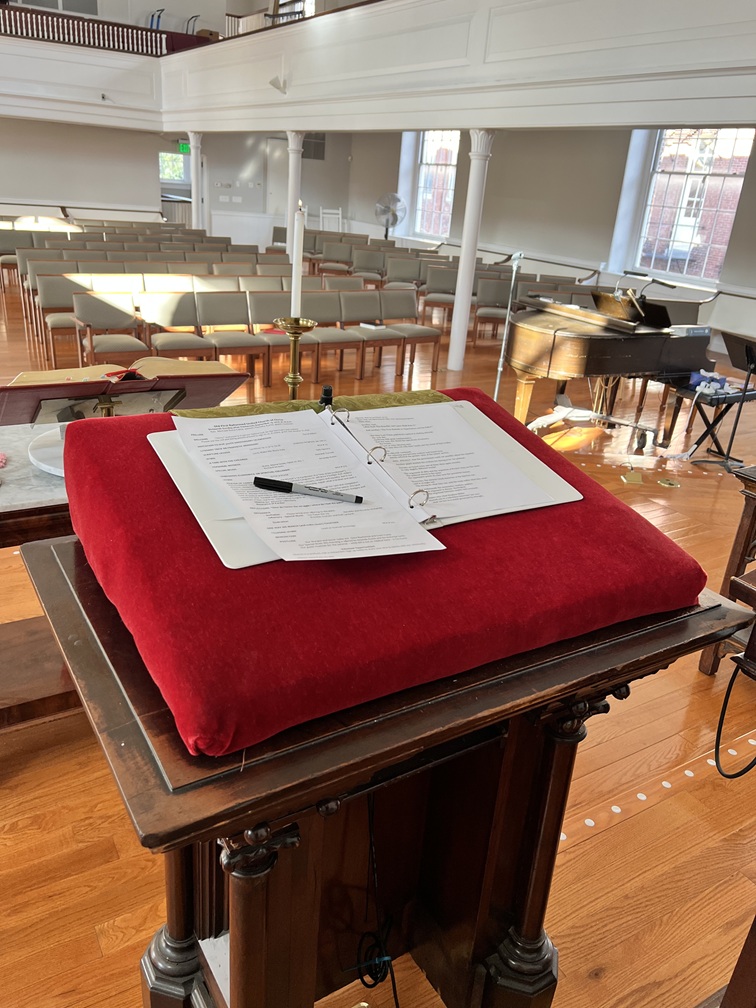
(With the second overflowing Sunday in a row,
Michael realized he needed to cut his sermon
drastically and on the fly.
He did (hopefully successfully),
but promised for anyone who wanted to read the whole thing,
that he’d post it online.
Voila’!)
When What’s Meant to Bring Us Together Separates Us”
1 Corinthians 11: 17-22 and 1 Corinthians 27-34a
“World Communion Sunday,” October 4, 2026
The Invitation to communion in this our congregation is to literally anyone
who finds some reason, ANY reason or even the slightest impulse.
I “invite ALL who want to join in the meal Jesus has prepare for us,
Come to this Table.
There’s room enough.
There’s food and drink enough.
There’s love enough.
Jesus promises!
We might say on a day like this, on World Communion Sunday,
the invitation is to all the world…
For all the world to come to the Table
AND
for those of us schooled in this Table Fellowship
to hear and respond to Christ’s invitation into the world…
At communion,
People often expect there to be restrictions.
Walls around the table like that little altar railing that used to be up front here.
But at Old First, we offer the bread and the cup to anyone who wants it.
No questions asked.
Because everyone has already be invited by Jesus.
And who are we then to interfere!
So there’s test.
No prerequisite.
No test.
No right answer.
It’s up to a person themselves,
Any person…
Just to have some inkling – maybe inexplicable –
of a desire to join us and Jesus at this Table,
to feel some perhaps surprising pull to participate.
To recognize some hunger, even craving
– I guess they’re apt metaphors –
for “something, “
perhaps something you can’t quite name
Or explain….
For God?
For interaction?
For acceptance?
Or forgiveness?
For feeling like you are connecting,
part of something.
For experiencing something bigger than yourself.
Or maybe just for a snack.
Somehow, beyond our understanding,
it’s all the Spirit’s invitation and conveyance
to something holy and sacred.
Church, there are too many communions
that are sad, lonely and depressing.
When a congregation is invited forward
And there are noticeable numbers of people
left in their seats
Because it’s been made clear
the table is not open to them.
When someone is hoping to find some communion
With God or neighbor,
Maybe any kind of communion,
But can’t keep from focusing on
the person they’re missing,
At odds with
Or separated from.
Remember, when Jesus suggests, “
if you are about to bring your gift to the altar
(that sounds like he’s talking about an offering,
and I guess he is,
but I think it really just means,
“when you are about ready to present yourself at the altar,
if you remember someone
who has something against you
or you have something against them,
wait on your offering,
set everything else aside
and go first to get right with your neighbor,
then come back to the altar…”
It’s hard to find communion
when all you can think of is
broken relationships
And people missing from your life.
I have a colleague who always tells the story
Of visiting a congregation in England.
And at the end of the service,
there was an invitation
to a communion service afterwards.
(What we call “intimate communion:
And offer after the main service
on the third Sunday of the month.)
My friend talks about trying get down the center aisle,
to move to the front of the sanctuary
Against the flood of everyone else leaving church.
And when he got there
it turned out it was “self-serve communion”
Whatever that is,
With a “self-serve, laminated liturgy.”
There was only one other person there,
an older parishioner there,
who rather than welcoming him
Or moving over ever so slightly
To indicate there was room for him,
Instead of helping him
make sense of what he should do,
or even inviting him to say the holy words together,
The other communista just looked interrupted, bothered.
Wherever 2 or 3 are gathered – not so much.
Or once, I was in church.
Visiting a church, with one of my kids.
I guess it was Benjamin
if I only had one child with me.
There was communuion.
I brought the toddler forward in my arms.
I took my piece of bread.
And my son reached for his.
But the plate was pulled back quickly.
I loved it when clear as day,
no hushed church whispers,
the obvious question comes from the mouth of a babe: .
Why didn’t I get any bread to eat?
Indeed.
I gave him mine.
We know the argument.
He was too young to understand.
I’d argue we all are.
Who understands God
or God’s grace?
Who merits the Table…
What?
…because we’ve mastered the mystery///
Communion isn’t a concept you understand.
It’s love you receive.
We dom’t earn love, or comprehend it.
You experience it.
Communion is inclusion,
an embrace,
something that happens to you.
Ok, it might be an invitation you accept.
Even a toddler figured that out:
“Eat this bread;
God’s somehow in it.
Not the pastor who’s just pretending to give it to you.
Because Jesus is really giving it to you.”
(Figure that one out!),
Jesus is always doing something radical,
But in his sharing of meals.
He clearly
— blatantly, out loud and unmistakably —
Celebrates open communion.
Jesus clearly shared food with everybody —
sometimes 5000 at a time —
including believers and unbelievers,
The righteous, sinners, the over-righteous,
clean and unclean
Jews and gentiles.
He demolishes the exclusions,
Takes back the restrictions and
Crashes through the taboos
around table fellowship –
both religious laws and cultural habits.
Think of how many meals and stories about meals
Jesus gives us.
In the majority of them
the meal includes outsiders.
He eats with pharisees
and tax collectors
and prostitutes.
He’s eating with Simon
and in comes an outsider, whom he welcomes.
With Zacchaeus Jesus himself is the outsider.
At the Last Supper Jesus includes Judas
(in the place of honor!)
In his parables, at the king’s wedding banquet
the poor and excluded are welcomed.
Jesus enacts the line from Psalm 23:
“You have prepared a table for me
in the presence of my enemies.”
Jesus invites them in!
ALL THIS is the community
Jesus intends to create around his table.
Where through his ‘ministrations’
we are all one.
Chrust’s It’s the one charge
they brought against him at his trial
that was actually true?
“He eats with sinners.”
Exactly….
That was his ministry,
so it’s the church’s ministry.
Calling all of us to one table.
Where
None are insiders,
none are foreigners,
none are deserving or undeserving.
All are simply invited / welcome / prized / loved.
It is ironic, even paradoxical
to preach that at this Table
we are in communion with Christians around the world
when Communion itself is among the things that divide us.
One can tragically say the same about religion itself.
It’s just plain wrong
to insist that one has to fit within some narrow definition,
belong to the reight sect
(yes, all denominations are sects)
to eat at this Table.
Paul says,
“All who eat and drink without discerning the body,
eat and drink judgment against themselves.”
We don’t read that verse often.
Because it’s almost always heard
and often understood to mean
you’re supposed to believe in
the Catholic teaching about transubstantiation,
That the sacrifice happens again,
That the bread and wine
become the physical body of Jesus/
But in light of what Paul is writing about,
that is, he’s in a long passage writing about the church,
I want to leave you with another interpretation,
I think Paul is writing the church in Corinth
And to us to,
Suggesting the obvious –
Jesus gathers us around the Table,
So we might see all who are at the Table,
Here we are to discern the body of Christ —
the community, the whole.
The holiness
of the mixed body
that only becomes Jesus’ body
in the self-giving love of God.
The bread and the cup,
the complete self-giving it symbolizes
open us to
the whole human community Jesus died for,
…including people of every every sort and type…
Doesn’t it just make sense
That in Jesus God cares about people
Of every tradition,
Sect. denomination, religion,
belief system
or unbelief.
The greater mystery to me is:
when we receive the Body of Christ
we become the Body of Christ.
We ourselves become the one loaf
he is offering us.
In some mixed up recipe,
We become part of one another.
In Romans and in 1 Corinthians
Paul talks about how church is the body of Christ.
Communion is the practice
that we are indeed one body,
part of one another.
When we eat the bread
it becomes part of our body.
And We see how we are part of the body.
How we become part of one another’s bodies.
We are one another.
So we love our neighbors as ourselves,
not just as much as we love ourselves,
but as ourselves:
as the rest of ourselves.
Dr. King said,
You can’t be who you ought to be
Until I am who I ought to be, and
I can’t be who I ought to be
Unitl you are who you ought to be.
It’s that kind of interconnectedness
We learn in church and
Practice and participate in at the communion table.
I don’t completely understand it,
but I’ve seen it
and I believe it…
Amen.